
Government hosted international nuclear power meeting
Published
On 8–10 December, 200 experts on nuclear power gathered in Stockholm for a workshop on small modular reactors (SMRs) organised by the Swedish Government and the OECD Nuclear Energy Agency (NEA). State Secretaries Maja Lundbäck and Daniel Westlén opened proceedings.
-
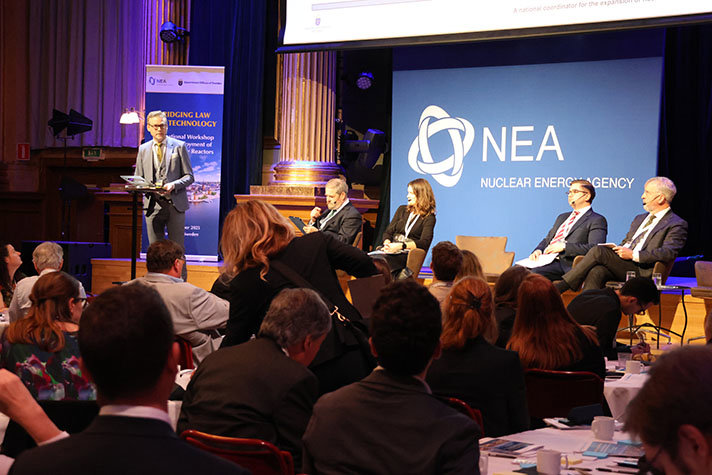
Panelists discussing legal issues related to SMR's. The Government’s national nuclear energy coordinator Carl Berglöf at the podium.
Photo: Gunilla Strömberg/Government Offices of Sweden.
-
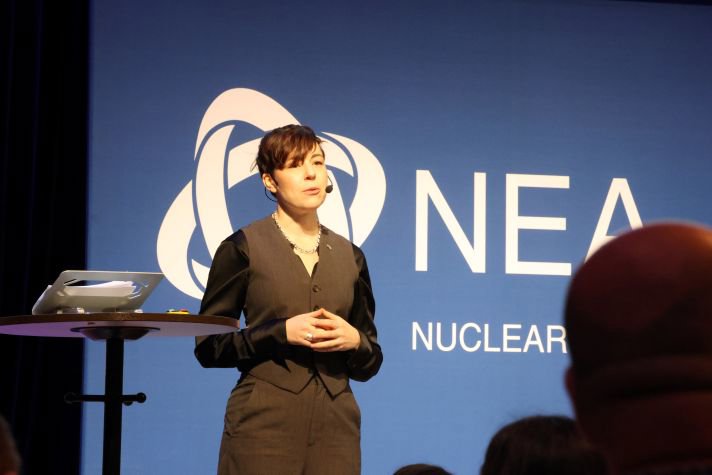
"We need to expand electricity production to meet demand", said State Secretary Maja Lundbäck in her opening address.
Photo: Jonatan Klefbom/Government Offices of Sweden.
-
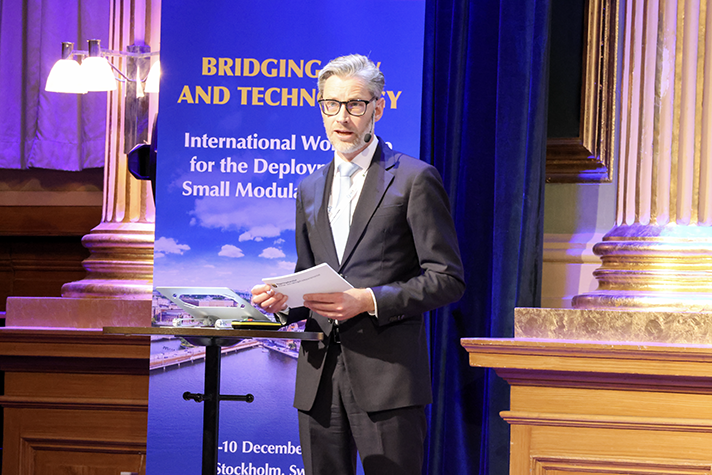
State Secretary Daniel Westlén highlighted the Government’s initiative removing the previous ban on establishing nuclear power plants.
Photo: Jonatan Klefbom/Government Offices of Sweden.
-
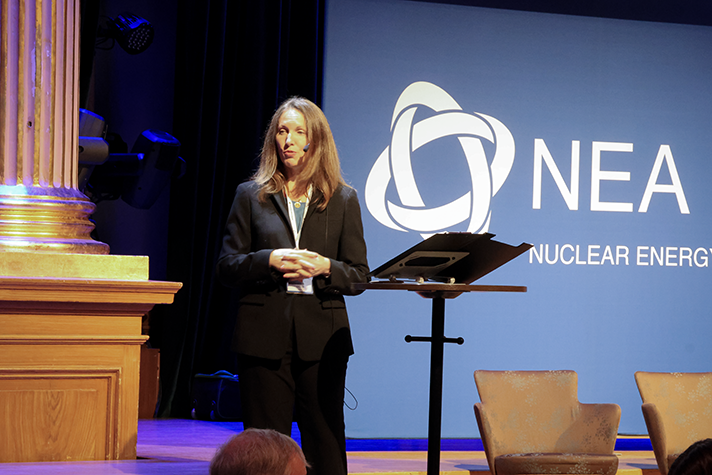
Kimberly Sexton Nick represented the managemant of the Nucelar Energy Agency.
Photo: Jonatan Klefbom/Government Offices of Sweden.


‘Bridging Law and Technology: International Workshop for the Deployment of Small Modular Reactors’ focused on legal challenges and potential solutions linked to the development of SMRs. The NEA is a multilateral agency within the OECD that facilitates cooperation among countries with advanced nuclear technology infrastructures to seek excellence in nuclear safety, technology, science, environment and law.
“Access to reasonably priced energy when and where it is needed is a matter of democracy and a necessary component of building a sustainable society. When it comes to nuclear power, Sweden is back. We need to expand electricity production to meet demand in step with the increasing electrification of both industry and the transport sector. Nuclear power must be given the same conditions as other fossil-free forms of energy,” said Maja Lundbäck, State Secretary to Minister for Energy, Business and Industry, Ebba Busch, in her opening address.
Powerful tool in climate action
Daniel, Westlén, State Secretary to Minister for Climate and the Environment Romina Pourmokhtari, highlighted the Government’s initiative removing the previous ban on establishing nuclear power plants on new sites, along with a range of other regulatory changes including streamlined permit procedures for new nuclear power plants. The Government’s efforts to create conditions for new nuclear power are laying the foundations for an effective climate transition and are in turn a prerequisite for achieving net-zero emissions by 2045.
“Although nuclear power was not originally introduced to reduce emissions, today we can see that it nonetheless became a powerful tool in climate action. Early nuclear power plants immediately led to a 30 per cent reduction in emissions, and emissions subsequently continued to decline while industry and households accessed cheap electricity. The Government is reviewing all legislation relating to nuclear power to enable new reactors to be built,” said Mr Westlén.
Participants from 32 countries
The Government’s and the NEA’s joint event followed last year’s ministerial conference ‘Roadmaps to new nuclear 2024’, which was held in Paris and jointly hosted by Minister for Energy, Business and Industry Ebba Busch and NEA Director-General Bill Magwood.
This year’s workshop involved around 200 participants from both the public and private sectors in 32 countries. Business sector participants included representatives of Rolls-Royce SMR, Hitachi Energy Sweden AB, Vattenfall and Blykalla. Director-General of the Swedish Radiation Safety Authority Michael Knochenhauer and the Government’s national nuclear energy coordinator Carl Berglöf took part in a high-level panel.
Support to international organisations
The Government has resolved to allocate SEK 1.4 million in financial support to the Nuclear Energy Agency (NEA) and the International Energy Agency (IEA). Fifty percent of the funds will be directed to NEA’s initiative aimed at accelerating the deployment of small modular reactors. The remaining fifty percent will be allocated to the IEA for the purpose of analyzing the role of nuclear power in the global energy system within the framework of the World Energy Outlook report.
